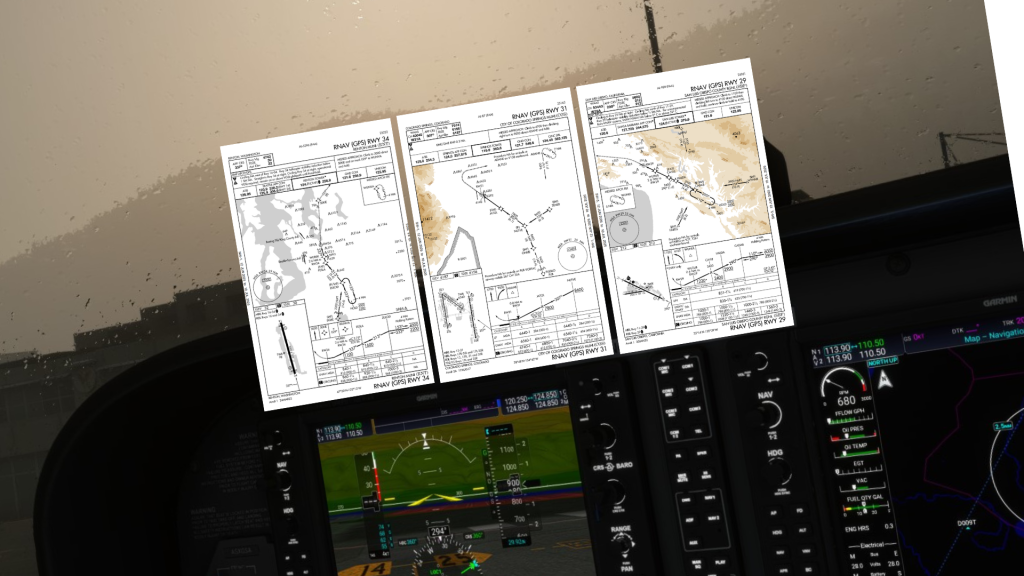
One of the most common challenges during instrument training is maintaining a stable descent on a non-precision approach. The tendency to “dive and drive”—descending steeply, then leveling off—increases workload and leads to unstable approaches. This article covers a simple, effective rule of thumb and the exact math behind it.
The “Diving and Driving” Problem
On an instrument approach without vertical guidance (like an LNAV-only approach), pilots must descend from one altitude fix to the next. A common mistake is to descend rapidly and then fly level until the next fix, creating a “stair-step” path. This requires constant power and pitch changes, making it difficult to fly precisely.
The Rule of Thumb for a Stable Descent
A much better technique is to fly a constant, stable descent. To do this, you need to know what your target vertical speed should be. The widely-used rule of thumb for a standard 3-degree glideslope is:
Vertical Speed (in FPM) ≈ Groundspeed (in knots) x 5
For example, if your groundspeed on final approach is 90 knots, your target vertical speed for a stable descent would be approximately 450 feet per minute (90 x 5 = 450).
The Math Behind the Rule
The “times 5” rule works so well because it’s a very close approximation of the exact trigonometric formula. Here is a step-by-step breakdown of how the precise formula is derived.
Step 1: The Core Relationship (Trigonometry)
Your aircraft’s descent path forms a simple right-angled triangle with the ground. (Note: The following text diagram is a simplified visual and is not to scale.)

Basic trigonometry (SOH-CAH-TOA) tells us that the Tangent of an angle is the ratio of the Opposite side to the Adjacent side. Since we want to find the relationship between vertical speed (Opposite) and horizontal speed (Adjacent), we start with this basic formula:
Vertical Speed = tan(Angle) × Horizontal Speed
Step 2: Matching the Units
This formula presents a problem: Vertical Speed is measured in feet per minute, but our Groundspeed is measured in knots (nautical miles per hour). We cannot mix these units. We must first convert our groundspeed into feet per minute.
- There are 6076 feet in 1 nautical mile.
- There are 60 minutes in 1 hour.
Therefore, to find the conversion factor, we divide the feet by the minutes: 6076 / 60 ≈ 101.27. This means 1 knot is equal to 101.27 feet per minute.
Step 3: The Final Formula & Comparison
Now we can substitute our conversion factor into the core formula to get the final, precise calculation:
Vertical Speed (in FPM) = tan(3°) × (Groundspeed in knots × 101.27)
Let’s compare this exact formula with the rule of thumb using our 90-knot example:
- Exact Calculation: tan(3°) × (90 × 101.27) = 478 FPM
- Rule of Thumb Calculation: 90 x 5 = 450 FPM
This detailed breakdown shows that the rule of thumb is a robust and reliable shortcut for a more complex calculation, making it an invaluable tool in the cockpit.