

While sometimes overlooked, rudder pedals are a key part of a realistic flight sim experience.
But what rudder pedals are the best for your flight simulator?
Let’s review what’s on the market in 2026.
The rudder pedals we analyzed will work with X-Plane, Microsoft Flight Simulator, and other PC-based flight simulators.
Not sure where rudder pedals fit in your overall setup? Start with our home flight simulator setup guide.
We know you’ll want to check the reviews before you buy any of these flight sim rudder pedals. So, we included links to independent review videos and articles so you can easily compare various options.
About us: We are not paid to include products in our guides. We don’t use affiliate links or accept compensation for reviews. Our goal is unbiased, experience-based guidance.
Note on pricing: The prices listed were checked in June 2026. Please check the latest prices and specs directly from the manufacturers’ websites.
What are the best rudder pedals for your flight simulator?
Here’s our quick summary:
- Best affordable rudder pedals: Thrustmaster T.Flight and Logitech G Flight
- Best mid-range rudder pedals: WinWing Orion and Honeycomb Charlie
- Best high-end rudder pedals: Thrustmaster Pendular Rudder (TPR)
- Best force feedback rudder pedals: Brunner CLS-E MK II
- Best Xbox rudder pedals: Turtle Beach Velocity 1
Your budget and flying goals will largely determine which rudder pedals to get. We have ordered the pedals primarily by price.
But what exactly do you get when spending more money?
- Better sensors. More expensive pedals usually use contactless Hall effect sensors. Better sensors let you precisely yaw the aircraft with even the smallest of pressures. Read more in the FAQ section.
- Better build quality. Higher-end pedals generally use more metal. This increases durability, reduces unwanted sliding against your floor, and feels more realistic.
In the end, all of the rudder pedals in this article will “get the job done” and give you a more realistic experience with good training value.
Your budget and goals for fidelity, quality, and flexibility will help you make a final choice.
If you’re budget-limited, consider starting with a less expensive set today. Then you can upgrade them later once you know what factors are most important to you.
Do you need rudder pedals to fly a flight simulator?

Not necessarily. However, we highly recommend rudder pedals for most serious flight simmers. Especially if you use your simulator for real-world pilot training or proficiency.
You might not need rudder pedals if:
- You have a joystick with a twist axis. That will let you control the rudder, but it has drawbacks:
- Differential braking can’t be controlled easily.
- Muscle memory (from twisting your hand) won’t transfer as easily to the foot movements required in real life.
- If you’re flying IFR and primarily want to focus on flying procedures where the rudder isn’t used very much
Who really should have rudder pedals? Real-world private pilot students.
You will benefit greatly from pedals because you can learn the correct muscle memory during takeoff (left-turning tendencies), slips, and taxi.
However, if you can’t afford them yet, don’t worry. You can still get plenty of value from your sim for everything else (like ATC, navigation, reading instruments, etc.).
Ok — let’s start by reviewing your options. We’ll break the pedals down into three main categories:
Are you not planning to practice hand flying, crosswind landings, and stalls? Do you mostly focus on flying IFR or airliners?
Then the benefits of premium rudder pedals are less worth it. Prioritize other items in your budget first and see what’s left over for pedals.
If you have an unlimited budget and want to invest in the best from the start, skip to the high-end options.

The most affordable flight sim rudder pedals (under $250)
Cheap rudder pedals are difficult to find.
The cheapest way to control the rudder is to use a joystick with a rudder twist control. For example, you can buy an Extreme 3D Pro Joystick for as low as $34.99.
But if you’re a student pilot, this won’t help you build the foot muscle memory that is critical for many maneuvers.
Dedicated rudder pedals start around $100. Let’s explore them below.

Thrustmaster T.Flight Rudder Pedals ($130)
Our instructors have worked with this in 10+ coaching sessions
The T.Flight Rudder pedals are a good entry-level option. They’re readily available on the market.
The pedals slide on four aluminum tracks, which Thrustmaster calls the S.M.A.R.T Rudder system.
Unfortunately, the pedal tension is not adjustable. There is a switch to select if you want to use the pedals as an aircraft versus a car/racing simulator. Be careful to set this properly during setup.
One feedback in reviews is that the pedals easily slide around on the floor. This can be mitigated by putting a spacer between the pedals and the wall
For drivers and troubleshooting, visit the Thrustmaster support page.
Comparison review videos: Thrustmaster T.Flight Rudder Pedals versus…
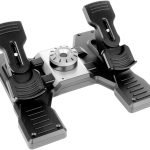
Logitech Flight Rudder Pedals ($180)
Our instructors have worked with this in 50+ coaching sessions
The G Flight Rudder Pedals pedals have an adjustable tension dial and adjustable footrests. This lets you select from three pedal lengths depending on your foot size.
For drivers and troubleshooting, visit the Logitech support page.
Comparison review videos: Logitech G Flight Rudder Pedals versus…

VKB T-Rudders Mk.V Rudder Pedals ($199)
The Mk.V rudder pedals stand out in this price category for their steel construction. They are a good option for someone wanting a durable, low-profile rudder pedal system.
The main downside is that they do not have toe brakes. You would need to assign a joystick/keyboard button to control brakes and differential braking.
Also, the angle of the footrests is very low and isn’t adjustable. This means your foot orientation isn’t as realistic as some other options.
You can see a video of the movement action here.

CH Products Pro Pedals
You can probably find a used pair of the CH Products Pro Pedals at a cheap price. These pedals have been around for decades.
Indeed, they may be the most budget-friendly option for actual rudder pedals on the list — if you can find them.
Comparison review videos: CH Products Pro Pedals versus…
Which rudder pedals are the best value (mid-range)?
These options offer improved build and sensor quality. They also offer more adjustability and flexibility. This lets you fine-tune the feel and simulate different aircraft types more realistically.

Turtle Beach VelocityOne Rudder Pedals ($320)
The VelocityOne™ Rudder pedals by Turtle Beach are a flexible option. They are especially well-suited for those using Xbox and other Turtle Beach hardware.
Like the other pedals in this category, they use non-contact Hall effect sensors.
However, unlike several other pedals in this price range which are made of metal, these have a plastic shell around the main metal base.
The most unique feature of the pedals is their compatibility with Xbox. However, you must also have the VelocityOne Flight Control System for this to work.
Adjustment features include:
Distance between the pedals (to match a particular aircraft and for optimum comfort)
Two variations of rudder pedal footrests — one for airliners and another for general aviation aircraft. Most of the other products we covered would require you to purchase additional pedal options separately.
Adjustable pedal angle
Two additional springs so you can adjust the pedal tension
These adjustments can be made very easily with a single tool that is included.
It offers a non-slip base with holes for permanent mounting, including a pad specifically designed for carpets. There are also screw holes if you wish to attach the pedals to the floor directly.
One reviewer commented that the pedals may be more noisy than other options. Another mentioned that the toe brakes may be lighter than other similar pedals.
These pedals would be ideal for those pilots who fly MSFS on Xbox and want the ability to customize their pedals.
For drivers and troubleshooting, visit the Turtle Beach support page.
Per Amazon listing
Virpil Controls R1-FALCON Rudder Pedals (€300)
A newer addition to Virpil's lineup, the R1-FALCON builds upon their previous ACE pedals with several key improvements. These pedals feature an all-metal construction with high-precision contactless digital sensors that offer input accuracy down to 0.02 degrees.
The R1-FALCON offers extensive customization options:
Infinitely adjustable spring tension via a simple twist dial
Swappable cam profiles (Hard Center, Soft Center, and No Center) for different feel preferences
Multiple spring options (Heavy and Standard) for varied resistance
Adjustable pedal spacing to match different cockpit setups
20-degree pedal angle adjustment range
Optional pedal tilt for center stick configurations
Like the MFG system, Virpil offers an optional Damper Upgrade Kit that can reduce spring bounce when returning to center and can be configured to hold the pedals in place.
The R1-FALCON features "half-foot" modern combat style aluminum pedals, making them particularly well-suited for military aircraft simulation. The heavy-duty floor plate provides excellent stability, while the cast metal foot pedals and CNC metal frame ensure durability.
For drivers and troubleshooting, visit the Virpil support page.
Reviews:
Magenta Debrief review — a hands-on write-up that's worth reading if you fly general aviation: it discusses how the "half-foot" combat-style footplates differ from a traditional GA pedal feel.
MFG Crosswind V3 graphite rudder pedals ($305)
The Crosswind V3 pedals are produced by MFG (Milan Flight Gear).
These pedals receive excellent feedback from the flight sim community. They're made from a sturdy composite material and some aluminum parts. MFG explains that non-metal construction is actually superior when using magnetic (Hall effect) sensors, since moving metal parts can disturb the magnetic field and reduce precision. Their composite material with 17 bearings is chosen specifically to preserve sensor accuracy and linearity.
You will need to buy a base unit, plus your desired variation of 3D-printed pedal footrests. They offer variations such as Cessna, Airbus, TBM, and others.
They use Hall effect sensors (high-resolution contactless magnetic sensors) that help ensure precision over the years.
They include several adjustment features:
- A knob to adjust the tension on the pedals.
- Adjustable pedal angle from 21° to 52°. You can go further to 61° by adding a support plate under the pedals or a width adjustment plate.
- Adjustable "Toe out" angle (see video)
- Wall spacers to help maintain the pedals stable against the wall behind your computer (see video). There are also holes to mount the pedals to the floor or a frame.
A hydraulic damper option is available, which can greatly improve the feel and realism of the pedals. Their damper has 23 adjustment levels. Some advantages of the damper system include:
- Smoother inputs
- Reduced spring-induced wobble
- Linear force throughout the entire movement range
- For rotorcraft: Can be configured to hold the pedals without a return to the center (anti-torque pedals)
- A better simulation of how an airliner's hydraulic system feels
For drivers and troubleshooting, visit the MFG support page.
Comparison reviews: MFG Crosswind V3 versus…
- Virpil VPC ACE Flight Pedals (Reddit and DCS discussions)
- Thrustmaster T.Flight Rudder Pedals
- Logitech G Flight Rudder Pedals (video 1 and video 2)
Community-reported

WINCTRL Orion 32 Rudder Pedals ($329)
The WINCTRL Orion 32 is designed specifically for airliner simmers who want Airbus-style pedals. WINCTRL is WinWing's new brand name as of 2026.
Key features:
Airbus-style footplates — Wider contact surface (54cm spacing) compared to traditional GA-style pedals, with the brake pivot point located closer to the heel for a more realistic airliner feel.
All-metal construction — Die-cast aluminum frame and base with stainless steel (SU304) for the return mechanism and critical load-bearing components. Heavy-duty anti-slip metal base.
Extensive bearing system — 24 ball bearings, 8 linear bearings, and 4 articulated bearings provide nearly friction-free and durable operation.
Hall effect sensors — All axes (rudder and brake) use high-precision contactless sensors for minimal wear and fine resolution.
Mounting options — Pre-drilled holes on base and sides for floor securing.
Available in two versions: standard ($329) and with damper ($373). The damper version provides smoother resistance.
Note: Currently available for pre-order with units expected to reach warehouses in 2-3 months. Limited quantities shipping now from the global store.
Reviews:
Flight Streamer review — hands-on flight test, covers the damper and the firm brakes.
simFlight overview (with damper).
WINCTRL Orion Rudder Pedals ($329)
Winwing makes the Orion Metal Flight Rudder Pedals. They utilize Hall effect sensors for smooth control. They feature a full-metal frame (aerospace-grade aluminum) and stainless steel for load-bearing parts.
It offers several control modes:
Fixed-Wing Self-Return-to-Center Mode (When you release the rudder pedals, they naturally move back to the center position)
Rotary-Wing High-Damping No-Return-to-Center Mode (the pedals stay where you push them)
Ground Vehicle Driving Mode
You can easily switch between these modes without needing any tools.
The pedal angle is also adjustable, and the pedals have a large range of travel (18 cm).
The “rebound” on the footrest is non-linear (see video here) and can give a more realistic toe brake feeling.
It comes with an extra-large anti-slip pad that works well on hard surface floors, as well as mounting holes on the bottom plates.
Reviews:
Threshold Review — "If you're coming from entry-level pedals, this is a galaxy apart. If you're an MFG user, it's a familiar experience with a heavier, tighter, and more premium character. These are rudder pedals you will have for many years."
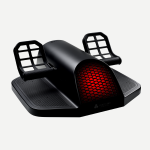
Honeycomb Charlie Rudder Pedals ($350)
Our instructors have worked with this in 20+ coaching sessions
The Charlie Rudder Pedals represent Honeycomb’s entry into the flight sim pedal market.
They utilize high-precision Hall which provides smooth, accurate control inputs without mechanical wear.
Key features include:
Adjustable pedal angle for customized foot positioning
Tension adjustment knob for fine-tuning resistance
Large pedal surface area for precise control
Belt-driven mechanism for smooth operation
The base features a thoughtful dual-surface design with rubber grip pads for hard floors, reversible carpet spikes for softer surfaces, and a large 47 x 50 cm footprint for stability.

MOZA MRP Rudder Pedals ($349)
The MOZA MRP Rudder Pedals launched at FlightSimExpo 2025 as part of MOZA's entry into flight simulation. Known for their sim racing equipment, MOZA brings similar build quality to these pedals.
Key features:
Swing-arm mechanism — Unlike traditional sliding pedals, the MRP uses a swing-arm motion that rotates around a pivot point. This provides smoother, more natural rudder input with up to 150mm of travel and ±30° rotation.
Metal frame construction — Aluminum alloy frame with high-strength steel swing arms and pedal plates. The heel rests are high-strength plastic.
Hall effect sensors — Both rudder and brake axes use contactless Hall sensors for precision and durability.
Adjustable pedal angles — Stepless adjustment from 0-30° to accommodate different seating positions.
Interchangeable springs — Customize centering force to your preference. An optional adjustable damper ($65) is available for finer resistance tuning.
The MRP can connect via USB for standalone use or via RJ11 directly to MOZA flight bases for full ecosystem integration.
Reviews:
Boosted Media review — calls them among the smoothest pedals he's tested.
Compare mid-range rudder pedals side by side:
| Turtle Beach VelocityOne Rudder Pedals $320 | Virpil Controls R1-FALCON Rudder Pedals €300 | MFG Crosswind V3 graphite rudder pedals $305 | WINCTRL Orion 32 Rudder Pedals $329 | WINCTRL Orion Rudder Pedals $329 | Honeycomb Charlie Rudder Pedals $350 | MOZA MRP Rudder Pedals $349 | |
|---|---|---|---|---|---|---|---|
| Construction | Plastic shell with metal base plate | All-metal (CNC + cast aluminum) | Composite material with aluminum parts, 17 bearings | Die-cast aluminum frame, stainless steel (SU304) return mechanism | Aerospace-grade aluminum, stainless steel load-bearing parts | Aluminum base and metal pedals with plastic housing | Aluminum alloy frame, high-strength steel swing arm and pedals |
| Sensors | Hall effect (all axes) | Contactless digital (0.02° accuracy) | Hall effect (13-bit, 8192 positions) | Hall effect (all axes) | Hall effect (all axes) | Hall effect (all axes) | Hall effect (rudder and brake) |
| Mechanism | Linear bearing | Pivot with 3 swappable cam profiles | Cam & arm centering, exchangeable CAM profiles | Heel-pivot pedals | Pivot/rocker with stainless steel center-return | Belt-driven | Swing-arm (±30° rotation) |
| Pedal Travel | — | — | Unknown | 150mm max deflection | 180mm | — | 150mm |
| Weight | 6.0 kg (13.3 lbs) [ref] Per Amazon listing | 8 kg | ~4.8 kg (reported) [ref] Community-reported | 8 kg | 6.6 kg (14.55 lbs) | 7.75 kg | 8.0 kg (17.6 lbs) |
| Damper | No add-on available | Yes — ~€40 add-on | Yes — sold separately, 23 adjustment levels | Yes — ~$44 add-on | Yes — ~$43 add-on kit | No add-on available | Yes — $65 add-on |
| Warranty | 1 year | 2 years | 2 years | 1-year limited | Unknown | 2 years (5-year tension band) | 12 months |
What are the most realistic rudder pedals for flight simulators?
The pedals in this category are much more expensive. In return, you will enjoy a more robust design and the highest-quality sensors.
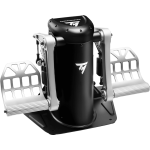
Thrustmaster TPR: Thrustmaster Pendular Rudder ($600)
Our instructors have worked with this in 20+ coaching sessions
If you’re looking for a robust set of rudder pedals with a realistic pedal angle, the Thrustmaster Pendular Rudder (TPR) pedals are a popular choice.
These pedals don’t “slide” like traditional flight sim rudder pedals. Instead, they swing back and forth around a pivot point (like a pendulum – this is why they’re called “pendular” rudders).
Another notable feature is that the dimensions and pedal angles are very realistic. You can easily keep your heels on the floor and use your toes for finer control as you would in a real aircraft.
The pedals can be adjusted to 5 angles (between 35° and 75°). You can also adjust the spring position to your desired stiffness.
The sensors are top-of-the-line. They use a patented “H.E.A.R.T. HallEffect AccuRate Technology” which incorporates 3D Hall effect magnetic sensors on all axes.
Due to the pendular design, they also take up less floor space compared to some other pedals.
For drivers and troubleshooting, visit the Thrustmaster support page.

Redbird Alloy RD1 ($599)
Redbird is known for producing its popular full-scale certified flight simulators. They also separately sell rugged RD1 rudder pedals.
It’s unclear if these pedals use Hall effect sensors. However, Redbird says their “advanced spring system” allows you to control the rudder with small input pressures.
The long base offers substantial rudder travel, but may require more floor space than some other options.
Do you own other Redbird hardware and want to stay in the Redbird ecosystem? The RD1 pedals may be a good option for you.
For drivers and troubleshooting, visit the Redbird support page.

Virtual Fly Flight Sim Rudder Pedals - Ruddo (€1,095)
VirtualFly is known for producing high-quality simulators and accessories. Their Ruddo rudder pedals utilize aluminum and steel parts. These are the same pedals used in VirtualFly’s certified simulators.
The rudder axes use hall effect sensors and “linear guide ball technology” for smooth motion. Load cell pressure sensors are used on the brake axes (these can detect very subtle changes in pressure compared to potentiometers).
The pedals are adjustable up to 4 levels of stiffness.
For drivers and troubleshooting, visit the VirtualFly support page.
Comparison review videos: VirtualFly Flight Sim Rudder Pedals versus…
Best force feedback rudder pedals
For the ultimate realism and immersion, consider rudder pedals with force feedback.
Unlike spring-based rudder pedals that provide constant resistance, force feedback rudder pedals actively simulate the physics of flight. The difference is dramatic – imagine:
- Feeling increasing pedal forces as your airspeed builds during takeoff roll
- Experiencing how rudder effectiveness changes at different airspeeds (heavier at high speeds, lighter at low speeds)
- Feeling the varying pressure required during ground operations as your taxi speed changes
- When using rudder trim, sensing the control forces neutralize as you find the sweet spot
Force feedback lets you truly feel how the aircraft’s aerodynamics affect rudder control forces, just like in a real aircraft.

CLS-E MK II Rudder Pedals (€1,799)
The top-of-the-line CLS-E (control loading system) offers an extremely robust, all-metal design. The force feedback will make it feel like you’re deflecting an actual control surface.
A few other advantages of this design include:
It supports single and dual-pilot applications. This means if you have a pilot and copilot station, each with a set of these pedals, they can be configured to move in tandem.
When the autopilot or rudder trim is engaged in a real airplane, they physically move the rudder pedals. The Brunner CLS-E can replicate this – you’ll actually see and feel your rudder pedals moving on their own when the autopilot makes rudder corrections or when you adjust the rudder trim, just like in a real aircraft.
It can simulate effects like shaking from the engine and ground.
They utilize contactless high-resolution sensors and the pedals offer 150 mm of travel.
The rudders communicate with your simulator (X-Plane, MSFS, and Prepar3D) via the CLS2Sim software.
For drivers and troubleshooting, visit the BRUNNER support page.
Review: G-LOC Media's hands-on review (updated 2026).
Coming soon: WINCTRL Force Feedback Rudder Pedals
WINCTRL (formerly WinWing) has announced force feedback rudder pedals that could shake up this category. The lineup includes:
- EB195 — $499.95, with 195 N of main-axis force
- EB590 — $799.95, with up to 590 N of force for the most demanding simmers
These were first shown at FSExpo 2025 and updated at the 2026 shows. As of mid-2026 they remain in pre-order and are not yet shipping. We’ll update this guide with full reviews once they become available. This would give simmers a more affordable force feedback option compared to the Brunner CLS-E.
On the horizon
At FlightSimExpo 2026, the sim-racing brand PXN showed its new NAVOS rudder pedal system as part of a full flight-sim hardware lineup. This is a conventional (non-force-feedback) pedal aimed at entry-to-intermediate simmers: an aluminum, foldable design with 16-bit Hall effect sensors, adjustable damping, and a switch between Airbus and Boeing pedal layouts. Pricing and availability had not been announced as of mid-2026. We’ll take a closer look once it ships.
What are the best rudder pedals for Xbox (with MSFS)?
At the moment, there aren’t many rudder pedals that are compatible with Microsoft Flight Simulator on Xbox Series X|S. Here are the main options.
Caution! These pedals can’t be directly attached to the Xbox, but must instead be attached to the peripherals described below.
- Turtle Beach Velocity 1 (also requires the VelocityOne Flight Control System)
- T.Flight pedals (must be connected to the a compatible peripheral like the Thrustmaster T-Flight Hotas One – see this article by Thrustmaster for details)
- Logitech G Pro Flight Rudder Pedals (requires the Honeycomb Xbox Hub and the Alpha Flight Controls XPC)
- Honeycomb Charlie (Alpha Flight Controls XPC & Honeycomb Xbox Hub are required for Xbox Series X|S compatibility)
More info about Xbox-compatible options is in this video.
Check out this article for more information about the pros/cons of using MSFS on Xbox.
What are the best rudder pedals for airliners (like the 737 and A320)?
If you are looking for rudder pedals to fly airliners in your flight simulator, any of the pedals discussed in this article could work.
However, consider these options if you would like airliner-style footplates:
- MFG Crosswind V3
- Turtle Beach VelocityOne™ Rudder
- Honeycomb Charlie Rudder Pedals
- Precision Flight Controls (PFC) Cirrus Rudder Pedals (Boeing)
- FSC B737NG PRO rudder pedals
Tillers for flight simulators

Remember that airliners are controlled on the ground primarily by tillers (operated by the captain). So for the ultimate realism, consider a tiller control as well. Here are some options:
- CAT 3 Design’s BOEING Steering Tiller and Airbus Steering Tiller
- FSC’s A320 Tiller PRO first officer side or B737 Steering Tiller FO
- Agronn’s B737 Steering Tiller
For a cheaper DIY approach, consider mounting a driving simulator steering wheel upwards.
Rudder pedal FAQ
Are flight simulator rudder pedals compatible with Mac?

Three pedals that explicitly advertise Mac compatibility are:
While manufacturers often don’t explicitly advertise Mac compatibility, many will indeed work. Rudder pedals usually connect via USB and rely on generic drivers that MacOS should recognize.
In many cases, if the simulator software you’re using supports Mac, the peripherals like rudder pedals should also be compatible.
However, it’s worth checking user reviews or forums for specific experiences with the pedals you’re considering.
It’s also important to note that while the hardware may work with MacOS, any custom calibration software provided by the manufacturer might not be compatible.
This could prevent you from using some advanced customization options. But the basic pedal functionality will likely still work.
Are the rudder pedals compatible with my simulator?
Rudder pedals are generally designed to be compatible with a wide range of flight simulators.
Most rudder pedals connect to your computer through USB. They will be recognized as generic input devices, making them broadly compatible across different flight sim software — including Microsoft Flight Simulator, X-Plane, Prepar3D, DCS, etc.
What is the advantage of Hall effect sensors?
Hall effect sensors offer a big leap over traditional potentiometers in flight simulator hardware. Here’s why they’re worth considering:
- No Sensor Wear: Hall effect sensors measure position using magnetic fields without physical contact between sensing components. While the mechanical parts of the pedals can still wear over time, the position sensing remains precise since the sensors themselves don’t experience physical wear.
- Better Precision: These sensors can catch tiny changes in position, giving you finer control and making the controls more realistic.
- Consistent Performance: Their accuracy is unaffected by dust or moisture.
In short, Hall effect sensors make your controls more accurate, reliable, and durable. If you can afford rudder pedals that use them, it’s a worthwhile investment.
Can I use racing pedals for flight simulators?

It’s technically possible. It could be a reasonable option if you already have a set or you find the prices cheaper than aviation rudder pedals.
You can use software like vJoy and Universal Joystick Remapper (UJR) to make the accelerator and clutch function as a single axis. While unrealistic for an aircraft, you would then use the brake pedal as a standalone brake function.
There are numerous disadvantages to this setup, especially for real-world student pilots. The movement won’t be like an aircraft rudder pedal and the two pedals won’t be coupled together. This means you can’t use the weight of one foot to help manipulate the sensitivity of the other rudder pedal. However, there are some ways to get toe brake functionality like the X-ToeBrake2Yaw plugin.
See this video for more information on setting this up.
How do rudder pedals work?

Rudder pedals are crucial for pilots to maintain precise control both on the ground and in the air. They have two primary movements.
Sliding Motion: This is the primary movement where the pedals side forward and backward. This moves the rudder surface on the vertical stabilizer. For aircraft with nosewheel steering, it also results in the nosewheel moving for steering during taxi.
Toe Brakes: Located at the top part of each pedal, toe brakes allow pilots to apply brakes individually to each wheel. This capability enables tight turns on the ground via differential braking (pressing one pedal more than the other).
Here’s a short video showing how rudder pedals are properly used in a Piper. Notice how the pedals slide left and right to apply the rudder, but rotate downward to apply brakes. In a Cessna, they look like this.
Your toes rest on the bottom of the pedals unless you’re actively applying brakes.
How do pilots use rudder pedals?
Rudder pedals are fundamental for effective aircraft control, including for:
- Taxiing: Pilots use rudder pedals to turn the airplane while taxiing on the ground. They use a combination of nosewheel steering and differential braking.
- Differential Braking: Applying more pressure on one pedal allows for tighter ground turns through differential braking.
- Crosswind Adjustments: During takeoff and landing in crosswinds, rudder pedals help keep the aircraft aligned with the runway.
- Counteracting Left Turning Tendencies: Right rudder is applied to balance the aircraft’s natural yaw to the left in single-engine propeller aircraft.
- Forward Slip: Used to increase descent rate without gaining speed, requiring rudder and aileron used in opposition.
- Engine Failure in Multi-Engine Aircraft: Rudder pedals allow the pilot to maintain directional control when an engine fails. They can counteract the yawing which is produced by the asymmetric thrust.
- Turn Coordination: Pilots use rudder pedals together with ailerons to prevent adverse yaw so turns are smooth and coordinated.


